

Generating ideas and creating web content creation ideas
Creating new web content that receives high levels of engagement, attracts website visitors, reaches a target audience, and generates leads is the biggest challenge marketers face with content marketing. Individually, those challenges are pretty much even split as the top 5 individual challenges marketers face, according to the 2024 State of Marketing report from Hubspot.
Creating content that meets one of those challenges is hard enough, but how do you create something that ticks all those boxes, and how on earth can anyone be that creative?
Okay, so some people are, but finding new ideas is a huge challenge for most marketers and if you’re juggling the dual hats of marketing a business, and running it, it’s going to be even harder.
Content marketing, although known to be extremely effective, is competitive and difficult. In this blog we’re going to share loads of ways you can find ideas and be inspired to create content. Then we’ll look at a few formats for delivering the best on the web content, so it reaches the right people and inspires them into action.
Finding ideas and inspiration for content creation
If you’re stuck in a rut and struggling to create content off the top of your head here’s a list of methods to get inspired with, and some different ways of presenting content to help you mix things up a bit. We’ve broken it down into groups so you can jump down to something that interests you in particular, or read them all.
- Reusing old content
- Personal experiences
- Digital tools
- Public opinion
- Social media
- Industry insights
Reusing old content
One of the first places you can look for new content, is content you have already produced! No, it’s not cheating; it’s economical. Reusing content makes the most out of your hard work, and provides the same helpful information in new formats or to new people:
- Refreshing old content for example, with more recent statistics or higher quality images. This is also really good for SEO!
- Create roundups of your own content into themes
- Go deeper into a topic you’ve already touched on by adding more to it
- Repost social media content at different times and compare the engagement results
Personal experiences
You can also take inspiration form yourself and your business and share your first-hand experiences through content:
- Case studies of internal and client success
- Lessons you’ve learned from failures
- Go ‘behind-the-scenes’ and showcase your work environment, team, or culture
- Create ‘how-it’s-made’ content about your products or services
Digital tools
There’s a myriad of both paid and free software available online that is designed to help with content creation. From blog topic generators to keyword research tools, here’s just a sample of digital tools you will find useful:
- Use the free AnswerThePublic to see what people search for online
- Do keyword research as part of your SEO process using paid tools like Ahrefs and Google Keywords Planner
- Google Search Console is a powerful, free, analytics tool that can tell you what is and isn’t generating traffic to your website
- Take advantage of paid and free AI tools like ChatGPT to generate ideas
- Type searches in Google and look at the suggestions, as well as the ‘people also ask’ feature
- Platforms like Canva and CapCut have readymade templates on lots of topics that you can use as is, or edit to be more specific to your brand
Public opinion and social media
People love sharing their thoughts and this is super helpful for anyone who needs content inspiration. People ask questions, answer questions, share resources, and have a different take on topics, in ways you may never have considered before. Here are some places you can find the unique perspectives and interpretations of the public for ideas:
- Groups (i.e. Facebook/LinkedIn)
- Forums (i.e. Reddit/Quora)
- Send surveys to customers and ask for their input
- Read the comments at the end of blogs, on social posts, and on news stories
- Check out FAQ sections and answer those questions in more detailed ways
- Find out what people love and hate about products and services through reviews and customer testimonials
- Visit media sharing sites like YouTube, SlideShare, Flipboard, and Flickr
Industry insights and competitors
Every industry has experts, niche topics, and events that can inspire creativity, so these are great sources to look to for ideas:
- Subscribe to industry newsletters and make time to read them
- Follow thought leaders on socials
- Attend networking and industry events, big and small
- Stay in touch with current events in the news and popular culture
- Read up about recent studies and discoveries
- Read reports and statistics from scientific and business perspectives, not just your own industry or niche
- Attend free webinars and talks
- Keep in the loop with what your competitors are doing – don’t copy them, but you can use their work as a springboard to develop alternatives and additions to your content
Presenting best on the web content
Now you’ve been inspired to create some top-notch content, what kind of formats can you present your topics in that make you look like an expert and reach the right people?
Back to content creation basics
First and foremost, to create best on the web content, there are some basics, and they matter whatever format your content comes in:
- Ensure your spelling and grammar is correct
- Make sure your work is proofread
- Plan and write your content to be optimised for SEO
- Use high quality tools
- Check your sources – keep them relevant, recent, and trustworthy
Building web content with hierarchical pages
In website building, parent and child pages are a basic hierarchical structure, that are kind of like headings and subheadings on a page – there is an overarching topic and that is broken down into similar topics. As an example from a simple website, a parent page could be About Us and then child pages from the About Us page would be Meet the Team and Careers.
We can use a hierarchy of webpages to demonstrate knowledge and authority on a particular subject when planning web content. Look at the example here for a law firm that wants to build content about their family law services.
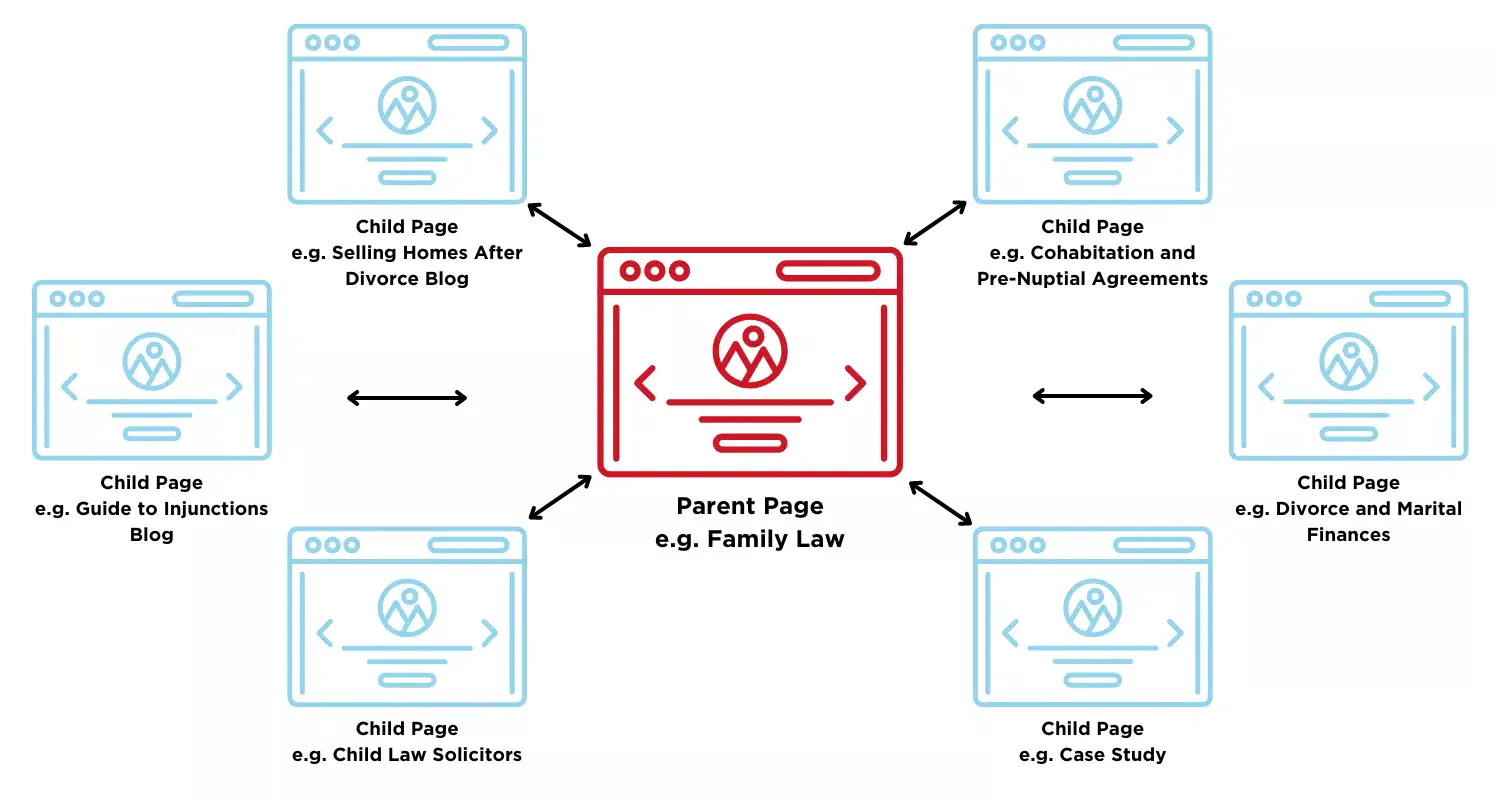
They start with the Family Law parent page and make sure the content on there is high quality and SEO optimised before linking it with other relevant pages. Some of the pages might exist already but some new pages may need creating with the hierarchy in mind. In this example, there are six child pages, and each one has a relevant topic that is helpful as a standalone page, but overall, link back to the parent page. More pages with blogs, services, case studies, testimonials, webinars etc. can be added as time goes on to expand the knowledge available and build on the hierarchical structure.
The benefits of creating content in a hierarchy are that it proves knowledge and confidence about a topic to potential customers. From an SEO perspective, content hierarchy builds internal links between pages, also showing a robust knowledge on a subject that Google rewards.
We explain more about parent and child pages in our live webinar on the subject ⬇️ along with examples and more information on this whole topic!
Delivering engaging web content
When you think of web content you probably think of a typical webpage and blogs as the go-to ways to present content. Pages and blogs are brilliant yes, but there are many other ways you can present content on a website. For example, live speaking events in public can be filmed and added to your website – you’re not just restricted to content that needs to be written.
In the first section of this blog, we shared 30 ways to get inspiration for content and many of them you can use to present your own content too. Even case studies can be both written, and filmed, both are suitable formats for website content.
At its core, content is either writing, audio, video, or images but the way you deliver that core content can be more creative:
- Case studies
- Frequently Asked Questions (FAQs) section on each page
- Myth busting or debunking common practices
- Give reviews of relevant products or services
- Roundups of your content or the content of others (with permission or citing of course)
- Interview industry professionals or customers
- Webinars
- Speak at events
- Workshops and training sessions
- Presentations or PDFs that can be downloaded from your webpage
There is more to web content than just blogs, though they do have their place! Websites are versatile and so are the ways people like to consume content, so hopefully this blog has inspired you to get creative and push your content creation boundaries.
Frequently asked questions about creating web content
What are parent and child website pages?
Parent pages are main pages, while child pages are subpages that branch off from them, creating a content hierarchy.
Can you re-use old marketing content?
Yes! Repurpose or update old content to keep it relevant and save time on creation.
Is keyword research important?
Absolutely, it’s vital really. It helps you understand what your audience is searching for and boosts your SEO ranking.
Are blogs still valuable for SEO?
Yes, blogs drive traffic, improve SEO, and provide fresh content that people (and search engines) love.
Should you test web content before publishing?
Just as creating compelling web content is key to engaging your audience, ensuring that your website and mobile applications work seamlessly is equally important. Rigorous testing helps catch glitches and enhance user experience, reinforcing your brand’s reputation for quality. AI driven visual testing streamlines this process, ensuring that every digital interaction is as flawless as the content you create.
Are you supposed to create websites for search engines?
No way, your customers are human people, so focus on making your website the best for them. Optimising your website for search engines (aka Search Engine Optimisation) is extremely important, but you should avoid focusing only on SEO tactics, and instead make user experience the priority.
Can you embed social media content onto a website?
Yes, embedding social media posts can enhance engagement and integrate your online presence.
Should you copy your competitor’s website?
No, focus on offering unique content and a better user experience. Copying can hurt your brand and SEO. Your content might be similar to theirs if you’re in the same business, but don’t copy it.
