
Search Engine Optimisation (SEO) is the practice of optimising a website, so it performs better organically in search engines. When users search for something online, they want answers that are relevant and good quality. By following the SEO best practice guidelines from search engines such as Google and Bing, you can get your website seen and trusted.
The coveted number one spot in search engine results is 10x more likely to be clicked than the next ranked website. The first page of results is more likely to be clicked than the second page and so on. Pages that rank very low will not see as much traffic as higher ranked pages. For a website to move up the rankings, there are several SEO tactics to employ.
In this blog we’re going to take you through some of the most effective SEO approaches for small businesses in a simple and easy-to-understand way. We’ll cover:
- The basics of SEO
- On-page SEO
- Off-page SEO
We’ll also talk about why SEO is important, especially in a recession. Lastly, we’ll leave you with a simple SEO checklist for you to keep and use for your own business.
SEO can be incredibly technical and complex, which is why there are highly qualified people who specialise in it. That doesn’t mean that the basic elements can’t be learned by small business owners and solo marketers who juggle more than just SEO.
The Basics of SEO
Let’s start with some explanations of common terms we’ll be including in this blog.
- Organic
- Crawling, indexing and ranking
- SERP
What Is Meant By Organic Traffic?
There are a few different types of traffic to websites, but they can pretty much be put into two categories, paid and organic. Paid traffic is sent to your website through advertising you’ve paid for such as on Facebook or through Google Ads.
Organic traffic is everyone who has visited your website unaffected by paid advertising. This could be from a search query on Google then clicking your website. It could also be because they know you already and deliberately search for your company name.
SEO helps drive more organic traffic to your website, if there is a good amount of search volume for your target keywords, because when you optimise your website properly, you will be ranked higher in the results page and be found by more people.
Bear in mind this only works if enough people are searching (search volume). You could have a perfectly optimised website in position number 1, but if no one is searching for that phrase, you won’t get any traffic.
The best marketing strategies include both paid advertising and SEO to drive organic traffic. If you are a small business and you don’t have much budget for advertising, SEO is your best bet for growth.
What Is Crawling, Indexing and Ranking In Google?
Google and other search engines use sophisticated software to read websites and find out what they are about. The programmes are often referred to as “bots” and the process is known as “crawling”. After each page is crawled, Google “indexes” the results into its database. When someone searches Google, the results from the index are ranked and displayed on a Search Engine Results Page (SERP) which is where you see the results of your search.
How Does A Search Engine Results Page (SERP) Work?
When a query is entered into Google or another search engine, the results are displayed on a SERP. SERP’s have features designed to help people find the results they want. There are a number of different ways Google present their results, with a view to making it as friendly to the user as possible. Google’s purpose is to try and provide the most relevant result to the end user as quickly as possible and so they provide a number of SERP features that help achieve that.
Here are some images of two search queries we’ve conducted on desktop computer. The queries we’ve asked Google was “what is threads?” and we’ve also searched for “onefoursix Northampton digital marketing”.
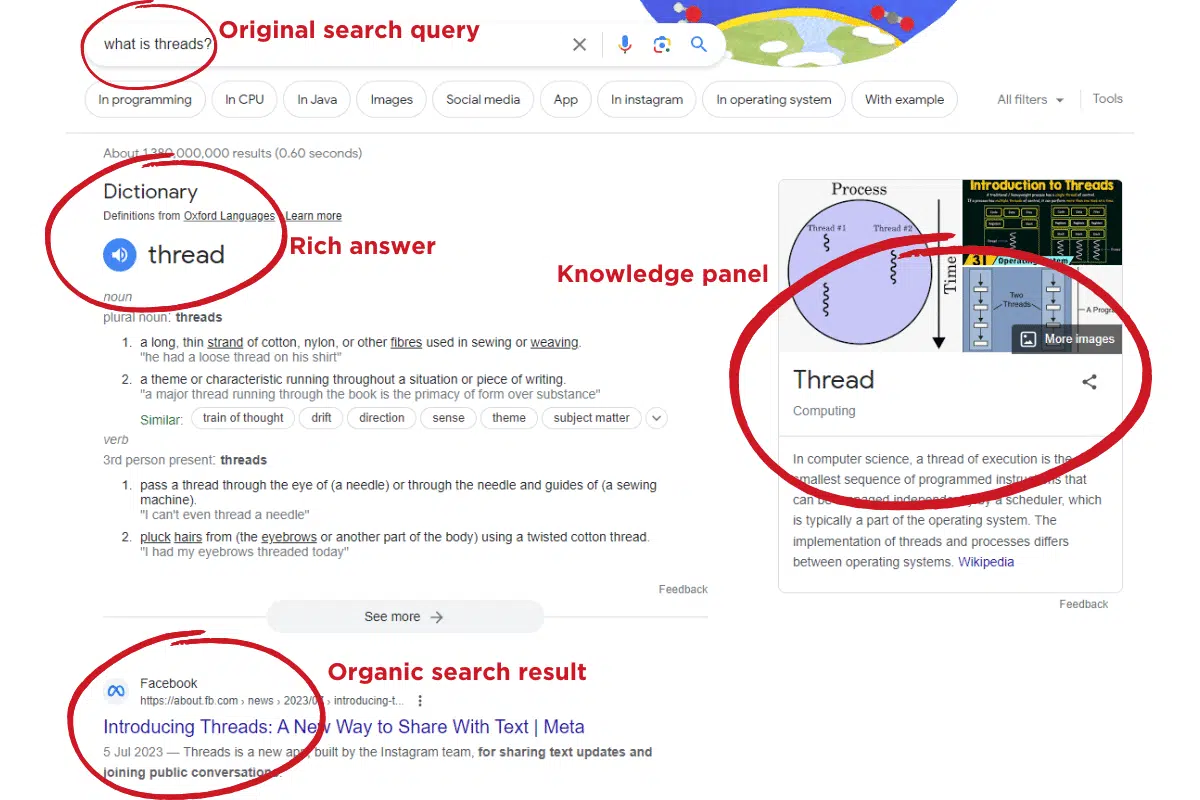
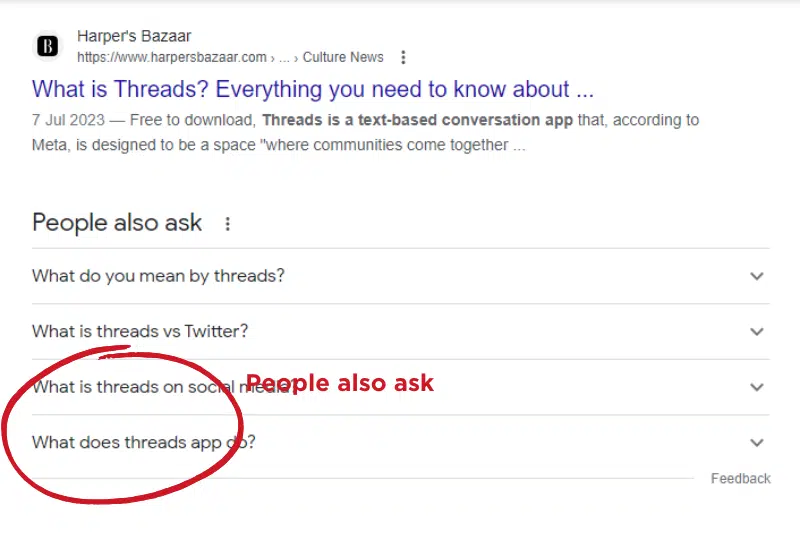
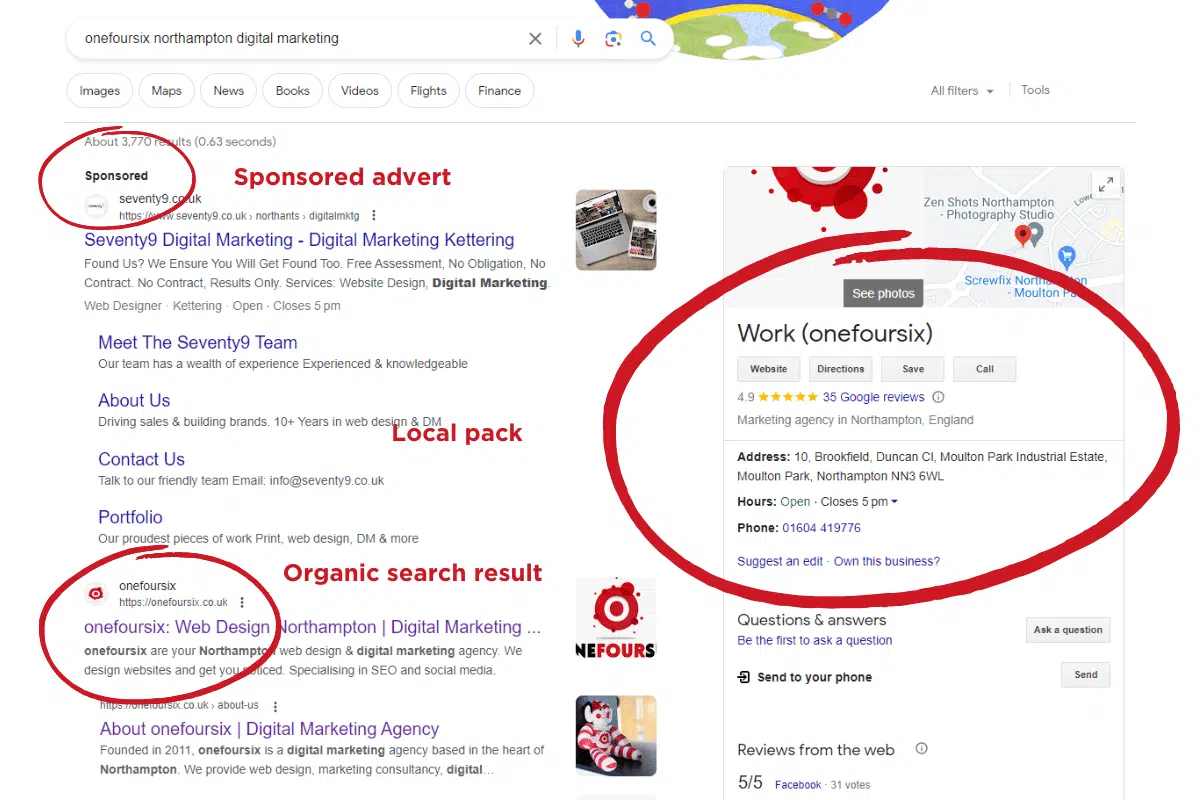
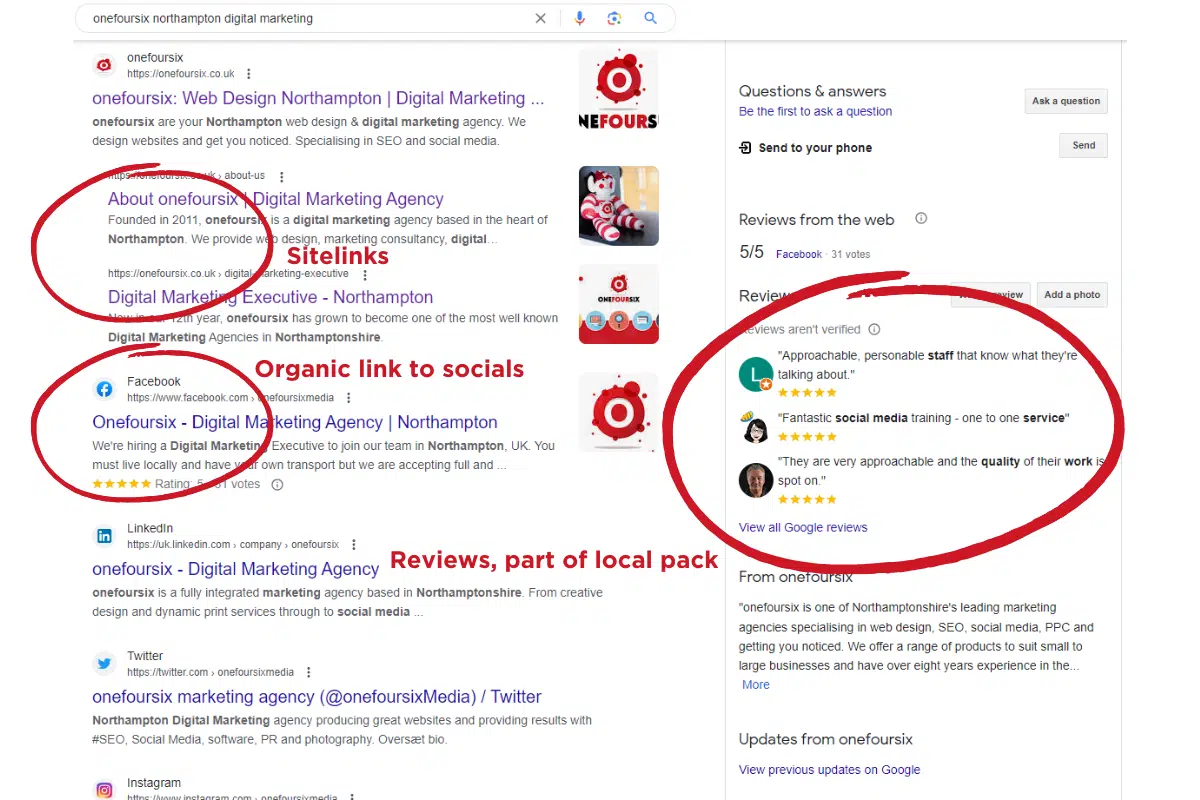
The results are presented in features:
- Rich answer
- Knowledge panel
- Organic search result
- Local pack
- Sitelinks
- People also ask
There are more features not included in these images including:
- Videos
- Image packs
- Top stories
- Rich snippets
- Image cards
They are all designed to show more about the answers people are getting. In some cases, like the rich answer dictionary definition of “thread” in image one, there isn’t even a link to the dictionary website.
We will go into more detail about local packs later in the blog but you can see in the image that reviews and details about a place appear if the information is comprehensive.
You can also see additional links that appear after the main organic search result for onefoursix. Our “About” and current vacancy pages are visible too. As are our social media pages.
The more we do to optimise our website, the more chance we have of featuring across a range of SERP features.
The Basics Of On-page SEO
A thorough on-page SEO strategy will consist of several different components, some of which are extremely technical. This article isn’t going to go into all of them though, as we said, we want to make this as accessible as possible. Instead, we’re going to focus on 5 things you can do to improve your on-page SEO without a great deal of technical knowledge.
- Keywords
- Content
- Headings and sub-headings
- Meta descriptions
- Page speed
What Are Keywords And Why Are They Important?
Keywords are the words people use in search engines to find answers, products and services. Ideally you want your website to contain the keywords people are most likely to search for, so the search engines match your website to their keyword search.
Understanding keywords is one of the most important parts of SEO. When you have a good keyword strategy it will help you understand your ideal audience and gives you direction for your content. Both factors will bring important organic traffic to your website.
Keyword research is also one of the most difficult activities to carry out for. As an agency, we use a keyword research tool to find out the keywords for websites, and we pay a subscription for access. If you are a small business you’re unlikely to be able to afford that so we’d recommend getting a free account with Semrush, you can do 10 free searches per day and they have an in-depth guide to keywords here. You can also use the Google Keyword Planner which is also free!
To a certain extent, some keywords don’t need a great deal of research to find out. If you’re an accountant in Northampton, one of your keyword phrases will likely be “accountants Northampton”. People put that query into Google and then the results are almost exclusively going to be for accountants in Northampton. The problem is, is that there are lots of accountants in Northampton so you’re going to be competing with them for the top spot on the search results.
Instead, let’s say that the accountant in our example, specialises in accounting for hospitality businesses. They may want to focus on the keywords “restaurant accountants Northampton”. This is more niche, and less people will be searching for it. Once you have a few keywords and phrases, you want to start using them in your website as part of your SEO.
The Right Website Content Helps SEO
There are a few factors that make website content rank well when it’s crawled and indexed. To start, it’s got to be relevant to your website. There is no point in our restaurant accountant filling their website about their fishing hobby. Instead, they need to add content that is related to their business.
Content can take different forms:
- Blogs
- Case studies
- FAQ’s
- How-to guides
- Service and product information
- Press releases
Content marketing can cross over with off-page SEO too; social media, influencers, press releases and guest posts are all examples of off-page SEO that can also improve your on-page SEO. Regardless of what form your content takes it should always be as good as possible. Google thinks high quality content should follow their EAT method.
- Expertise
- Authority
- Trustworthy
In addition, content should be comprehensive and easy to read. Think about the top 10 results on Google, to rank there your content needs to be one of the actual top 10 pieces of content.
Using Headings and Sub-Headings for SEO
We’re talking about the headings of your content here. When search engines crawl websites, they use headings and sub-headings to get context on what it’s about. This means it’s important to include keywords in those sections.
Search engines will also penalise websites for using too many keywords, also known as keyword stuffing. It’s a balance you will get used to as you use analytics tools to make sure your website is performing well. If you use an SEO analysis tool you’ll see there is a recommended number of times a keyword should be mentioned.
What are Meta Descriptions?
Under the page title link in a SERP, are a few words known as the meta description. It’s important to write the meta description so people know what to expect from your webpage before they click on it. There is a meta description for every single page on a website and all of them should be filled out with the keywords about that page and tell people what to expect.
There is evidence to suggest that whilst meta descriptions may have limited impact on ranking positions, it has an impact on click through rates CTR. i.e it can entice a searcher to click on that result if the meta description is appealing.
How Does Page Speed Impact SEO?
It’s important to optimise your page for page speed to be the quickest it can be as Google have confirmed this is a factor that affects ranking. You can check your page speed using a free tool by Google.
Just to clarify, this isn’t a check for your internet speed, it’s a check to how fast the whole page loads up for a user. Factors that would affect the speed could be images that are too large or having unused JavaScript present. Phrases like Largest Contentful Paint refer to how long everything on the website loads and Google thinks it should be under 2.5 seconds.
If you do the page speed test, you’ll also see something called Core Web Vitals Assessment. This is a list of everything Google thinks the website should be doing. It marks performance, accessibility, SEO and best practice out of 100 with recommendations on how to improve.
It’s important that whoever looks after your website checks and fixes any issues with page speed as soon as possible, it’s part of regular website maintenance.
So, What Is Off-page SEO?
Now we’ve covered some aspects of on-page SEO we can move onto optimising off-page. In this section we’ll cover:
- Local SEO
- Link building
- Social media
How Can Local SEO Help Small Businesses?
There is a Google feature called Google Business Profile. It’s designed for a business to add their information so what is displayed on Google search results is accurate. It gives businesses the opportunity to add in the exact location, services, opening times, images, contact details and more. There is an easy verification process that means only one business can claim it’s theirs and it gives potential customers additional information.
To optimise for local information, make sure your company information on your Google Business Profile account is up-to-date and comprehensive. Add updates, images and news regularly. You will want to do the same for the Bing version of this which is called Bing Places for Business.
Furthermore, depending on your business type, you will want to check that Yell, TripAdvisor, Check A Trade, Thomson Local and other online directories have also got your details correct. It’s usually straightforward to create a free account with them and get your details updated. This really speaks to Google’s need for trustworthiness. If it can crawl the web and find all the details about your business are the same, it adds legitimacy.
How Do You Use Link Building For SEO?
Another great way of establishing trust with Google is by adding links to your website, from other trustworthy and authoritative websites. These links are called backlinks and the more high-authority backlinks you have, the happier Google is. The more Google trusts your website, in turn will give your website prevalence in results.
Think of authority in websites as the difference between buying something from a shop that has been established for 20 years, has a great reputation, with trained experts and a loyal customer base, or buying from a sketchy looking dude with a makeshift stall in an alleyway. One is more trustworthy and authorative than the other.
An example of a high-authority website for our restaurant accountant, would be the Institute of Chartered Accountants in England and Wales (ICAEW). It’s legitimate, trustworthy, and full of expertise.
The links in this blog are to high-authority websites and I can check them using an SEO tool we have access to. If you don’t have access to tools like that, you can use common sense to determine whether you think the website is high-authority or not.
Using Social Media For SEO
SEO and social media go together as it’s another avenue for people to find out about your brand. It’s also a great place to share links to your website. Every time someone clicks the link in your Instagram bio, it adds a bit more trustworthiness and legitimacy to how Google sees your website.
Social media isn’t officially taken into account by Google when ranking websites, but it is considered to help significantly. If you use a free analytics tools to measure your website like Google Analytics, you will see it measures the traffic that come to your website from social media.
In the image below, you can also see that when I searched for onefoursix, Google displayed our Facebook, LinkedIn, Twitter and Instagram accounts on the SERP.
Why Is SEO Important For Small Businesses During A Recession?
We’ve covered a lot in this blog, and hopefully you can see that, although it’s time-consuming and complex, when you use free tools like Google Analytics or the free Semrush account, it doesn’t cost anything to have a basic SEO strategy.
SEO is a long-term part of marketing that is never finished but can yield great results. That’s why it’s such an important element to learn and work on during a recession, and anytime really. At the very basic level, it doesn’t require a huge marketing budget and monthly subscriptions and that makes it a valuable skill to learn when other companies who rely only on paid advertising, start slashing their budgets.
SEO is a really broad topic and it encompasses a great deal of different elements. It’s easy to see why it’s glossed over by solo businesspeople when they are juggling so many plates at once. The fact that it’s so broad demonstrates why it’s so vital, it’s a fundamental part of digital marketing now.
The aim of this blog was to give a straightforward breakdown of some SEO strategies anyone can pick up and implement.
If you’re running a small business, carrying out an SEO audit will give you an idea of how your SEO is working at the moment. You can also use the action plan included above.
We’ve spoken a lot about the benefits of SEO in this blog but we also need to give a reality check. SEO isn’t “free”, because to do it properly takes time, which means someone has to do it and that will cost something somewhere. It’s also not a quick fix, it doesn’t deliver instant results. That’s why it’s best to do in conjunction with other marketing activities. In this world of digital first consumer behaviour, it’s too important not to be included.
We recorded a webinar on this topic on 25th July 2023, you can watch the whole video on our YouTube channel or below ⬇️
Commonly asked questions about SEO strategies for small businesses
What are the top three SEO strategies?
Focus on quality content, keyword optimisation, and building backlinks to boost your site’s visibility.
What are the best local SEO strategies for small businesses?
Optimise for local keywords, claim your Google Business profile, and encourage customer reviews.
What is organic SEO?
Organic SEO helps your site rank naturally in search results without paid ads, through good content, keyword, and backlink strategies.
Why is SEO important for business?
SEO increases visibility, drives organic traffic, and helps attract potential customers without needing to pay for ads.
How to write SEO content?
Use relevant keywords naturally, write engaging content for your audience, and structure it with headings, meta tags, and internal links.
What is an SEO audit?
An SEO audit reviews your site’s SEO health, checking for issues like broken links, slow loading times, and keyword optimisation.
